
24/7 Hydrojetting Services in Mesa, Arizona
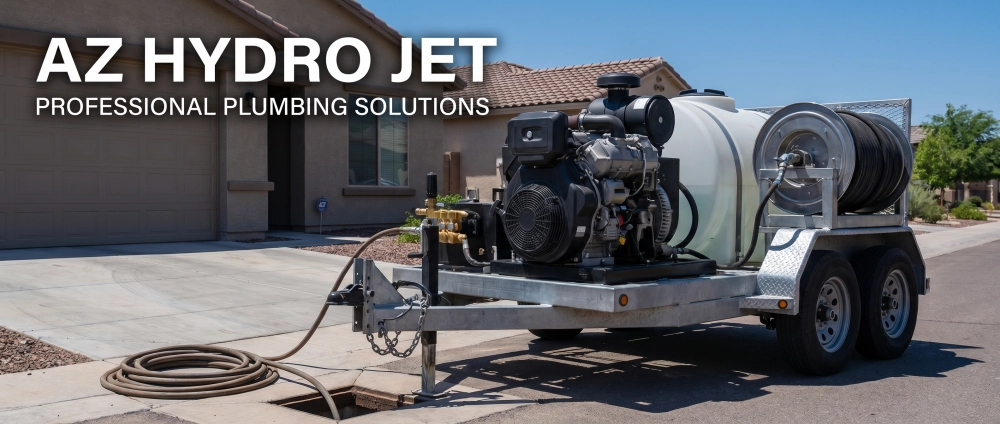
AZ Hydro Jet restores full pipe capacity in Mesa's sewer laterals and commercial mains using trailer‑mounted rigs that deliver 4,000 PSI at 12–15 GPM. Rotating carbide cutter nozzles and HD sewer cameras eliminate the calcium scale, invasive roots from citrus and mesquite trees, and hardened grease blockages that threaten the city's broad mix of historic and modern infrastructure. Immediate 24‑hour emergency response.
Why Mesa Sewer Lines Fail
Mesa's underground infrastructure faces a unique combination of moderately hard water, expansive Salt River floodplain soils, a vast canopy of old citrus trees that became part of residential landscapes, and a mix of 1920s–1950s clay and cast iron pipe that predates modern materials. Standard drain snaking only punches a temporary hole through these accumulating problems; it does not restore the pipe.
Hard Water Scale (14 gpg average)
Mesa's drinking water, sourced from the Central Arizona Project and deep wells, averages 14 grains per gallon (240 ppm). This calcium carbonate load precipitates continuously inside pipes. In a 4‑inch cast iron lateral, scale buildup reduces effective diameter by roughly 0.5 inches per decade, cutting flow capacity by 25–30%. The scale layer also provides a rough surface that traps grease and debris, accelerating blockages.
Floodplain Clay & Pipe Separation
Mesa sits on the broad floodplain of the Salt River, where expansive clay soils swell and shrink with seasonal moisture. This constant movement stresses buried joints—especially the mortar‑filled connections of vitrified clay tile installed before the mid‑1960s. Homes in the Evergreen, West Second Street, and Robson Historic Districts still operate on these original laterals. Joint separation, vertical offsets, and root ingress at every open joint are the expected findings in camera inspections.
Root Intrusion – Legacy of the Citrus Groves
Mesa was once blanketed in citrus groves. Many residential neighborhoods still feature mature orange, grapefruit, and lemon trees whose thick, water‑seeking roots now threaten underground plumbing. Add native mesquite and palo verde, and the result is a constant, year‑round battle below ground.
Orange, grapefruit, lemon
Legacy orchard trees send thick roots 40+ feet, exploiting clay joints and hairline cracks. Common in Dobson Ranch and older neighborhoods.
Velvet & honey mesquite
Taproots extend 50+ feet, penetrating mortar joints and cast iron cracks. The most common root found in Mesa residential laterals.
Windbreak trees
Massive roots crush old clay tile from the outside, then fill the interior. Often found along Mesa's historic irrigation laterals.
Desert ornamentals
Both species produce dense, fibrous root balls that wrap around pipes, trapping debris and accelerating blockage formation.
Commercial FOG – Mesa Restaurant Compliance
Mesa's dining scene stretches from Downtown Mesa and Main Street to the Fiesta District, Southern Avenue, and Superstition Springs. Every food service establishment must adhere to Maricopa County FOG regulations: install and maintain gravity grease interceptors, pump quarterly, and document within 5 days. However, the lateral pipes upstream and downstream of the interceptor still collect a cement‑like mixture of grease and calcium soap. Hydrojetting at 2,500–4,000 PSI with 140°F water is the only method that fully scours these lines and provides a compliance‑ready video record for inspectors.
Technical Execution Protocol
Every Mesa job follows a proven four‑phase sequence. No water pressure is applied before the HD camera confirms the pipe can withstand it—especially critical in the expansive clay soils and century‑old lines of Mesa's historic districts.
HD Camera Diagnostic
Pan‑and‑tilt camera with integrated sonde maps pipe material, joint offsets (common in Mesa's floodplain clays), scale thickness, and the exact location of root masses. Collapsed, severely offset, or longitudinally fractured pipes are flagged and excluded from jetting. The full video recording is provided to the property owner.
Nozzle Selection & Pressure Calibration
Based on camera findings, we select the optimal nozzle: forward‑jet for sludge and FOG, rotating carbide cutter (3,000‑5,000 RPM) for citrus, mesquite, and eucalyptus roots, high‑impact penetrator for calcium scale. Pressure is calibrated to the pipe's material and age: 1,800‑2,500 PSI for PVC/ABS, 2,500‑3,500 PSI for sound vitrified clay, up to 4,000 PSI for structurally intact cast iron.
Hydro‑Mechanical Scouring
The nozzle is inserted at the upstream cleanout and propelled downstream toward the municipal tap. This upstream‑jetting technique creates a hydraulic sled: 12–15 GPM of water volume suspends scale, shredded roots, and grease, carrying all debris out of the line. For commercial FOG, water temperature is elevated to 140°F to melt and emulsify calcium‑soap deposits. Rotating nozzles ensure 360° coverage.
Post‑Jet Video & Compliance Report
A second camera pass documents the fully restored pipe. We compare before/after footage with you on‑site, confirming complete scale removal, root elimination, and full bore restoration. Digital copies are delivered immediately. Commercial accounts receive a date‑stamped report formatted for Maricopa County FOG inspection.
Residential & Commercial Application Profiles
| Parameter | Residential | Commercial Kitchen |
|---|---|---|
| Typical Pipe | 3"–4" lateral | 4"–8" kitchen lateral & main |
| Materials | Vitrified clay, cast iron, ABS, PVC | PVC, cast iron, HDPE |
| Main Blockages | 14 gpg scale, citrus/mesquite/eucalyptus roots | FOG + calcium soap, food solids |
| PSI Range | 1,800–4,000 (material‑dependent) | 2,500–4,000 |
| Flow Rate | 12 GPM | 15 GPM (6"+) |
| Frequency | 5–7 years; 3‑yr camera if trees nearby | Monthly/Quarterly (code compliance) |
| Compliance | Property owner maintenance | Maricopa County FOG + Mesa Code |
| Access | Exterior mainline cleanout | Downstream of 3‑compartment sink & interceptor |
| Documentation | Before/after HD video | Video + compliance report |
| Failure Cost | Sewage backup into home | Red tag, fines, closure |
Mesa Case Study: Evergreen District Grapefruit Rescue
1935 Bungalow – 4" Vitrified Clay Lateral
A homeowner near Country Club Drive and University had been snaking the main line every six months for four years. Camera inspection of the 4‑inch clay lateral—original to the 1935 home—revealed 0.6 inches of calcium scale and a dense root ball from an 80‑year‑old grapefruit tree at the third joint.
The carbide cutter nozzle at 3,500 RPM under 3,000 PSI sheared the grapefruit roots completely. A penetrator nozzle then removed the scale layer. Post‑jet video showed a full 4‑inch clear bore. Flow rate jumped from 13 GPM to 39 GPM. The homeowner has now established a video baseline for future monitoring and saved the cost of seven additional snake jobs over the next five years.
Long‑term savings: $1,575 in avoided snaking fees.
200% flow improvement
Root source: 80‑yr grapefruit, 35 ft away
Pipe age: 89 years (1935)
Snaking avoidance: $1,575 over 5 yrs
Why AZ Hydro Jet
We know the citrus, soil, and pipe eras
From Evergreen clay to Dobson Ranch PVC, we tailor pressure and nozzle selection to Mesa's exact conditions.
Day or night, we answer
A certified technician picks up the phone. No answering service. We arrive in Mesa within 60‑90 minutes for emergencies.
PACP trained and tested
Every field technician holds Pipeline Assessment Certification, ensuring accurate diagnosis and safe execution.
Camera‑backed safety
We never pressurize a pipe without pre‑inspection. Full insurance and bonding. Video proof of every job.
Mesa Neighborhoods & ZIP Codes Served
1910s–1930s clay laterals
1920s bungalows, old cast iron
1930s–1940s clay & iron
1970s PVC, citrus root pressure
Newer PVC, FOG compliance
Commercial/retail laterals
1980s–2000s mixed pipe
Mixed vintage, restaurant row
Serving all Mesa ZIP codes: 85201–85210, 85213, 85215, 85216, 85275 and surrounding areas.
Frequently Asked Questions
How much does hydrojetting cost in Mesa?
Can hydrojetting break old clay pipes in Mesa's historic districts?
How often should I hydrojet my Mesa sewer line?
Does hydrojetting remove citrus and mesquite roots?
Are you really available 24/7 in Mesa?
What about restaurant grease trap compliance in Downtown Mesa?
AZ Hydro Jet
CONTACT INFO:

Reliable Hydro-Jetting solutions for residential, commercial, restaurant and more.
Home
Services
Copyright Mountain AZ Plumbing 2026. All rights reserved