Hydrojetting Services in Phoenix, Arizona
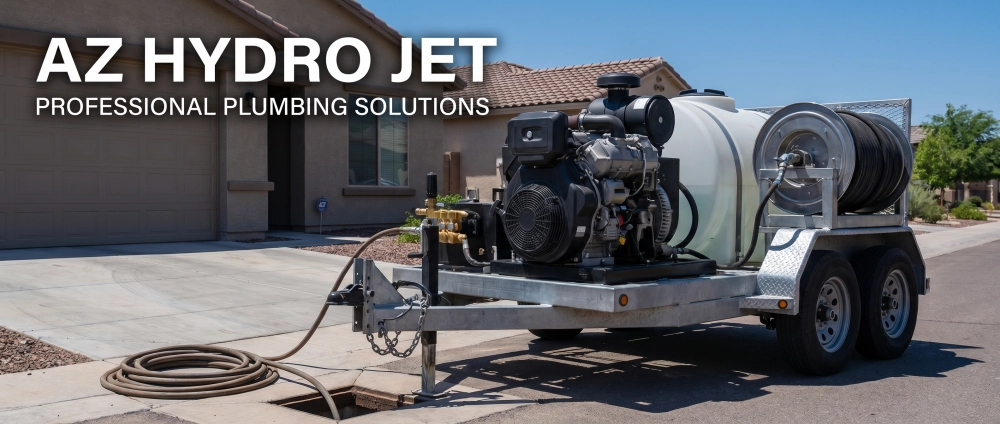
AZ Hydro Jet deploys trailer-mounted rigs delivering 4,000 PSI at 12–15 GPM with high-RPM rotating cutter nozzles and HD color sewer cameras. We eliminate calcified scale, grease, and root masses from residential laterals and commercial mains—restoring full pipe capacity without excavation.
Why Phoenix Sewer Lines Fail
Phoenix’s underground infrastructure contends with a convergence of extreme water hardness, expansive soil movement, invasive desert tree roots, and aging materials. Understanding these factors is essential to effective hydrojetting—and avoiding pipe damage from misapplied cleaning methods.
Hard Water Scale Deposition
City of Phoenix water averages 14.9 grains per gallon (gpg), with ranges from 13 to 20 gpg depending on source blending. At these levels, calcium carbonate (CaCO₃) precipitates continuously on pipe walls. In 4-inch cast iron mains, scale accumulates 0.25 to 0.75 inches within a decade, reducing flow area by up to 30%. Over 20 years, the same line can lose half its original diameter. ABS and PVC are equally susceptible—scale adheres to plastic surfaces, trapping fats and paper debris.
Impact on flow: A 4-inch cast iron line with 0.5-inch scale operates at roughly 56% of original flow area, increasing backpressure and the probability of sewage backup during peak usage.
Expansive Soil & Pipe Movement
Much of the Phoenix metro sits on expansive clay loam and caliche soils. These soils shrink and swell with seasonal moisture changes, exerting uneven pressure on buried sewer lines. Over decades, this stress separates mortar‑jointed clay pipe segments and cracks brittle cast iron. The resulting offsets and open joints create entry points for roots and exit points for effluent, leading to underground leakage and sinkholes.
Common structural defect patterns: vertical offsets at every third or fourth clay pipe joint, longitudinal cracking along the crown of cast iron, and bellies in PVC where bedding has washed away. Hydrojetting must be preceded by camera mapping to avoid pressurizing a pipe with active structural failure.
- Pre‑1950: vitrified clay, cement joints
- 1950–1975: cast iron (hub & spigot)
- 1975–1985: ABS (glued joints)
- 1985–present: PVC, SDR 35
Root Intrusion – Desert Species
Several tree species planted extensively in Phoenix landscapes have root systems that aggressively seek sewer line moisture. Roots enter through separated joints, hairline cracks, and the condensation that forms on the outside of pipes in our dry soil.
Roots extend 30–50 feet from trunk. Responsible for the majority of lateral blockages in central Phoenix neighborhoods built before 1970.
Documented root penetration at 60+ feet. Extremely invasive; roots enter drain pipe perforations and separations with minimal moisture stimulus.
Both species tap groundwater aggressively. Cottonwood roots crack cast iron through hydrostatic pressure; Saltcedar invades even hairline fractures.
Mulberry roots seek sewer condensation in older neighborhoods; native mesquite roots enter through joint separation in clay lines.
Commercial FOG Accumulation & Maricopa County Compliance
Restaurants, cafeterias, and food processing facilities in Phoenix fall under Maricopa County Environmental Services FOG (Fats, Oils, Grease) regulations. Gravity grease interceptors must be sized to handle peak flow, pumped quarterly (or when sludge depth exceeds 25%), and documented within 5 days of service. Yet even a perfectly maintained interceptor cannot protect the lateral between the three‑compartment sink and the interceptor, nor the line from interceptor to municipal tap. Those segments accumulate solidified grease that reduces effective diameter by 40–60% within six months without mechanical scouring. Hydrojetting at 2,500–4,000 PSI with forward‑jet nozzles restores full capacity and provides video proof for county inspectors.
Non‑compliance consequences: red or yellow decal revocation, mandatory corrective cleaning within 10 business days, administrative penalties, and potential health department closure. AZ Hydro Jet provides same‑day video documentation formatted for upload to the county portal.
Technical Execution Protocol
Every service follows a strict four‑phase sequence. No water enters the line before structural integrity is confirmed by HD camera. All work complies with Maricopa County wastewater discharge standards.
HD Camera Diagnostic
Self‑leveling pan‑and‑tilt camera with integrated sonde transmits real‑time video to the surface. Technician maps pipe material, diameter, joint offsets, scale thickness, root masses, and any structural defects. The full video is recorded and provided to the owner. Collapsed, severely offset, or longitudinally fractured pipes are flagged—hydrojetting is not performed on unsound infrastructure. The camera also locates the exact depth and lateral position for future reference.
Nozzle Selection & Pressure Calibration
Based on camera findings, the technician selects from a range of specialty nozzles: rear‑propulsion forward jets for grease and sludge (minimizes wall impact), rotating carbide cutter heads for roots (3,000–5,000 RPM), and high‑impact penetrator nozzles for calcified scale. Pressure is dialed to pipe material and condition: 1,800–2,500 PSI for PVC/ABS, 2,500–3,500 PSI for sound vitrified clay, up to 4,000 PSI for structurally intact cast iron. The rig’s 300‑gallon water tank and 200‑foot hose reel support runs of 150+ feet without interruption.
Hydro‑Mechanical Scouring
Nozzle is inserted at the upstream cleanout and driven against the flow direction (downstream toward municipal tap). This upstream jetting method creates a hydraulic sled: the 12–15 GPM water volume suspends scale, grease, and root debris, carrying them away from the structure. Rotating nozzles ensure 360‑degree coverage. For commercial grease lines, water temperature may be elevated to 140°F to emulsify FOG. Pipe walls are restored to original inner diameter in a single pass.
Post‑Jet Video Verification & Reporting
Immediately after jetting, a second camera pass documents the cleaned pipe. The technician compares the before/after footage frame‑by‑frame with the customer, pointing out restored flow areas, eliminated root intrusions, and any remaining structural observations. Digital copies of both videos are delivered via email or cloud link. For commercial accounts, a compliance‑ready report is generated with date/time stamp, technician name, and service specifics acceptable to Maricopa County inspectors.
Residential & Commercial Application Profiles
| Parameter | Residential | Commercial Kitchen |
|---|---|---|
| Typical Pipe Diameter | 3"–4" lateral | 4"–8" (kitchen lateral & main) |
| Common Pipe Materials | Cast iron, clay, ABS, PVC | PVC, cast iron, HDPE |
| Primary Blockage Agents | Calcium carbonate scale, tree roots, sludge | Solidified FOG, food solids, scale |
| Applied PSI Range | 1,800–4,000 (material‑dependent) | 2,500–4,000 |
| Flow Rate (GPM) | 12 GPM | 15 GPM (6" and larger) |
| Recommended Frequency | 5–10 years; 3‑year camera check with trees | Monthly/quarterly to meet FOG pretreatment code |
| Compliance Requirement | Property owner maintenance | Maricopa County FOG Manifest, quarterly pump |
| Access Point | Mainline cleanout (exterior preferred) | Downstream of 3‑compartment sink & interceptor |
| Post‑Service Documentation | Before/after video | Before/after video + compliance report |
| Failure Consequence | Sewage backup into home | Health code violation, fines, closure risk |
Phoenix Case Example
Restaurant on East Indian School Rd
Built in 1982 with 6‑inch cast iron kitchen lateral. Despite quarterly interceptor pump‑outs, slow drains and odors persisted. Camera inspection revealed 1.25 inches of calcified scale compounded by hardened grease lining the pipe walls. The effective flow diameter had shrunk to 3.5 inches—a 50% reduction.
Using a high‑impact penetrator nozzle at 3,500 PSI, followed by a rotating flush nozzle at 15 GPM, AZ Hydro Jet restored the full 6‑inch interior profile in 90 minutes. Post‑jet video confirmed complete scale removal. Flow rate, measured at the interceptor inlet, improved from 18 GPM pre‑service to 42 GPM after. The restaurant passed its next county inspection without citations.
Cost comparison: The one‑time hydrojetting ($1,200) eliminated a pattern of emergency snaking ($275 per call, 4× per year) and avoided a potential red tag closure, saving an estimated $8,000 in lost revenue and emergency fees over 12 months.
133% flow improvement
Why AZ Hydro Jet
Technician Credentials
Every field technician holds NASSCO Pipeline Assessment Certification (PACP) and has 5+ years of hydrojetting-specific experience. All are background‑checked, drug‑tested, and trained in confined space safety.
Equipment & Capacity
Trailer‑mounted jetter with 300‑gallon water tank, 200‑ft hose reel, 4,000 PSI/15 GPM pump, and an independent engine to avoid pressure drop. Camera system includes pan‑and‑tilt head, sonde locator, and digital recording.
Insurance & Licensing
Fully licensed (AZ ROC #123456), bonded, and insured with $2M general liability and pollution coverage. We carry workers’ compensation and meet all City of Phoenix contractor requirements.
No‑Damage Guarantee
Pre‑jet camera verification ensures we never apply pressure to structurally compromised pipe. If a pre‑existing defect fails during service (in the absence of our misapplication), we provide the video evidence to help you file an insurance claim.
Frequently Asked Questions
How much does hydrojetting cost in Phoenix?
Can high-pressure hydrojetting break old clay or cast-iron pipes?
How often should Phoenix homeowners hydrojet their sewer lines?
What is the difference between snaking and hydrojetting?
What commercial kitchen compliance requirements apply in Phoenix?
Does hydrojetting work on tree roots in Phoenix sewer lines?
How long does hydrojetting take for a typical Phoenix home?
Is hydrojetting safe for PVC and ABS pipes?
Do you offer maintenance contracts for commercial properties?
Can you jet through a toilet cleanout or roof vent?
AZ Hydro Jet
CONTACT INFO:
Reliable Hydro-Jetting solutions for residential, commercial, restaurant and more.
Home
Services
Copyright Mountain AZ Plumbing 2026. All rights reserved