
24/7 Hydrojetting Services in Scottsdale, Arizona
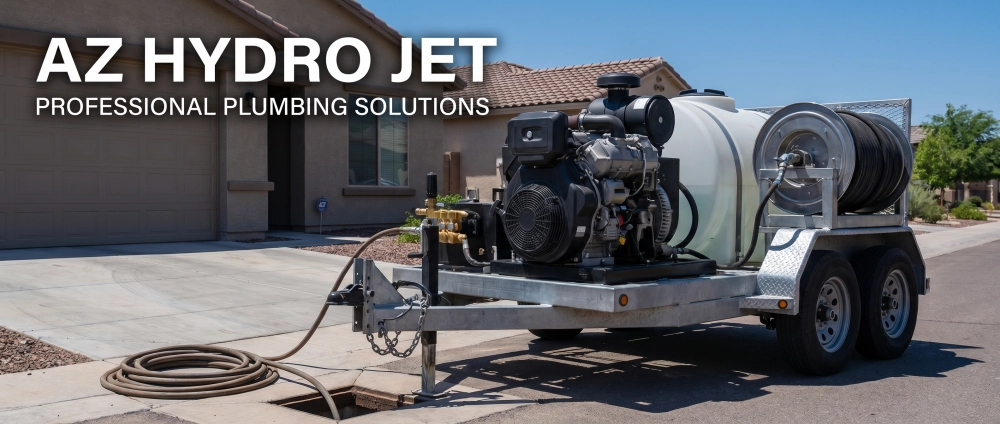
AZ Hydro Jet returns Scottsdale's sewer laterals and commercial mains to full capacity with trailer‑mounted rigs delivering 4,000 PSI at 12–15 GPM. Rotating carbide cutter nozzles and HD sewer cameras remove calcium scale, dense roots from olive and palm trees, and solidified FOG deposits that standard snaking leaves untouched. Immediate 24‑hour emergency dispatch.
Why Scottsdale Sewer Lines Fail
Scottsdale's underground network contends with hard water that leaves calcium deposits, expansive soils that shift pipes, and a canopy of mature olive, palm, and mesquite trees that send roots deep into laterals. Many estate properties and Old Town blocks still run on original clay or cast iron pipe installed between the 1920s and 1950s. Routine snaking buys temporary flow but never reverses the underlying scale and root intrusion.
Hard Water Scale (14 gpg)
Scottsdale's water supply—a blend of CAP canal water and local groundwater—averages 14 grains per gallon (240 ppm). This consistent mineral content precipitates calcium carbonate onto pipe walls. In a 4‑inch cast iron lateral, scale builds approximately 0.5 to 0.7 inches per decade, reducing effective flow area by 30–45%. The rough surface then traps food waste, paper, and grease, accelerating clogs.
Expansive Soils & Aging Pipe Joints
Much of Scottsdale sits on layers of expansive clay and caliche. Monsoon storms soak the soil, clay swells; drought shrinks it. This ongoing cycle flexes buried sewer lines, pulling apart mortar‑jointed clay tile connections. Homes in the Old Town, Arcadia, and McCormick Ranch corridors frequently show pipe offsets and root‑open gaps during camera inspections. Cast iron from the post‑war era develops crown cracks and internal tuberculation under the same stress.
Root Intrusion – Scottsdale's Distinctive Landscape
Scottsdale's high‑value landscaping includes olive trees, Mexican fan palms, citrus, and native mesquite. Their roots relentlessly seek the moisture and nutrients inside sewer pipes. Year‑round warmth keeps roots active, so blockages can form in any season.
Signature Scottsdale tree
Fruitless olive varieties send thick, moisture‑seeking roots 40+ feet. They infiltrate clay joints and wrap around pipes, crushing from the outside.
Resort staple
Palm roots create dense fibrous mats that enter even hairline cracks, snag debris, and quickly choke a lateral.
Native desert species
These natives tap into sewer lines 50+ feet away, entering through mortar joints and hairline cracks.
Legacy grove trees
Remnant orange and grapefruit trees from old farms send thick roots into clay laterals. Common in McCormick Ranch and southern Scottsdale.
Commercial FOG – Old Town & Resort Compliance
Scottsdale's high‑density restaurant scene—Old Town, Scottsdale Road, Fashion Square, and the resort belt—must comply with Maricopa County FOG regulations. Grease interceptors require quarterly pump‑outs and documented manifests. Yet the laterals connecting three‑compartment sinks to interceptors, and interceptors to city mains, accumulate a rock‑hard compound of grease and calcium soap. Hydrojetting at 2,500–4,000 PSI with 140°F water is the only mechanical cleaning that restores full diameter and yields video proof acceptable to inspectors.
Technical Execution Protocol
Every Scottsdale service follows a strict four‑phase sequence. No water enters the pipe before the HD camera confirms structural integrity—a critical step given the age and soil movement of Scottsdale's older districts.
HD Camera Inspection
Pan‑and‑tilt camera with sonde locator maps pipe material, joint offsets from expansive clay, scale depth, and root mass locations. Any collapse, fracture, or offset greater than 30% of pipe diameter disqualifies the line from jetting. Full video provided to the property owner.
Nozzle Selection & Pressure Setting
Forward‑jet nozzles for sludge and grease; rotating carbide cutter heads (3,000‑5,000 RPM) for olive, palm, and mesquite roots; high‑impact penetrator nozzles for thick calcium scale. Pressure is calibrated to pipe material: 1,800‑2,500 PSI for PVC/ABS, 2,500‑3,500 PSI for sound vitrified clay, up to 4,000 PSI for structurally intact cast iron.
Hydro‑Mechanical Scouring
Nozzle enters at the upstream cleanout and jets downstream, using 12–15 GPM of water volume to create a hydraulic sled that suspends and removes all debris. For commercial FOG lines, water is heated to 140°F to liquefy calcium‑grease deposits. Rotating nozzles ensure 360° wall contact in a single pass.
Post‑Jet Video & Documentation
A second camera pass documents the fully restored pipe. We review before/after footage with you on‑site. Digital copies are delivered immediately. Commercial clients receive a time‑stamped, inspector‑ready report with video evidence.
Residential & Commercial Application Profiles
| Parameter | Residential | Commercial Kitchen |
|---|---|---|
| Typical Pipe | 3"–4" lateral | 4"–8" kitchen lateral & main |
| Materials | Vitrified clay, cast iron, ABS, PVC | PVC, cast iron, HDPE |
| Main Blockages | 14 gpg scale, olive/palm/citrus roots | FOG + calcium soap, food solids |
| PSI Range | 1,800–4,000 (material‑dependent) | 2,500–4,000 |
| Flow Rate | 12 GPM | 15 GPM (6"+) |
| Frequency | 5–7 years; 3‑yr camera with trees | Monthly/Quarterly (FOG code) |
| Compliance | Property owner maintenance | Maricopa County FOG + Scottsdale Code |
| Access | Exterior mainline cleanout | Downstream of 3‑compartment sink & interceptor |
| Documentation | Before/after HD video | Video + compliance report |
| Failure Cost | Sewage backup into home | Red tag, fines, closure |
Scottsdale Case Study: Old Town Olive Root Intrusion
1948 Ranch Home – 4" Vitrified Clay Lateral
A homeowner near Scottsdale and Indian School Roads suffered recurring backups every 6–8 months. The 4‑inch clay lateral, original to 1948, had been snaked five times in three years. Camera inspection revealed 0.7 inches of calcium scale and a massive root ball from a 55‑foot fruitless olive tree at the fourth joint.
A carbide cutter nozzle at 3,500 RPM under 3,200 PSI sheared the olive roots completely. A penetrator nozzle then removed the scale. Post‑jet video confirmed a full 4‑inch clear bore. Flow rate increased from 11 GPM to 35 GPM. The homeowner saved $1,375 in avoided snaking over five years and now has a documented video baseline.
218% flow improvement
Root source: 55‑ft fruitless olive
Pipe age: 76 years (1948)
Snaking avoidance: $1,375 over 5 yrs
Why AZ Hydro Jet
We know the trees, soil, and vintage pipe
From Old Town clay to McCormick Ranch PVC, we calibrate every job to Scottsdale's unique underground conditions.
Certified techs answer day or night
No answering service. A real technician takes your call and an emergency crew arrives in Scottsdale within 60‑90 minutes.
PACP trained and tested
Pipeline Assessment Certification means accurate diagnostics, safe pressure selection, and full documentation.
Camera‑backed safety
We never jet without verifying pipe integrity first. Fully insured and bonded. Video evidence provided for every job.
Scottsdale Neighborhoods & ZIP Codes Served
1920s–1940s clay laterals
1950s cast iron & clay
1970s PVC, palm root pressure
Estate properties, olive trees
1980s–1990s mixed pipe
Commercial FOG compliance
Restaurant grease management
Larger PVC, hard water scale
Serving all Scottsdale ZIP codes: 85250, 85251, 85252, 85253, 85254, 85255, 85256, 85257, 85258, 85259, 85260, 85261, 85262, 85266, 85267, 85268, 85269, 85271.
Frequently Asked Questions
How much does hydrojetting cost in Scottsdale?
Can hydrojetting break my old clay pipes in Scottsdale?
How often should Scottsdale homeowners hydrojet?
Does hydrojetting remove olive and palm roots?
Are you available 24/7 in Scottsdale?
What about restaurant FOG compliance in Old Town Scottsdale?
AZ Hydro Jet
CONTACT INFO:

Reliable Hydro-Jetting solutions for residential, commercial, restaurant and more.
Home
Services
Copyright Mountain AZ Plumbing 2026. All rights reserved